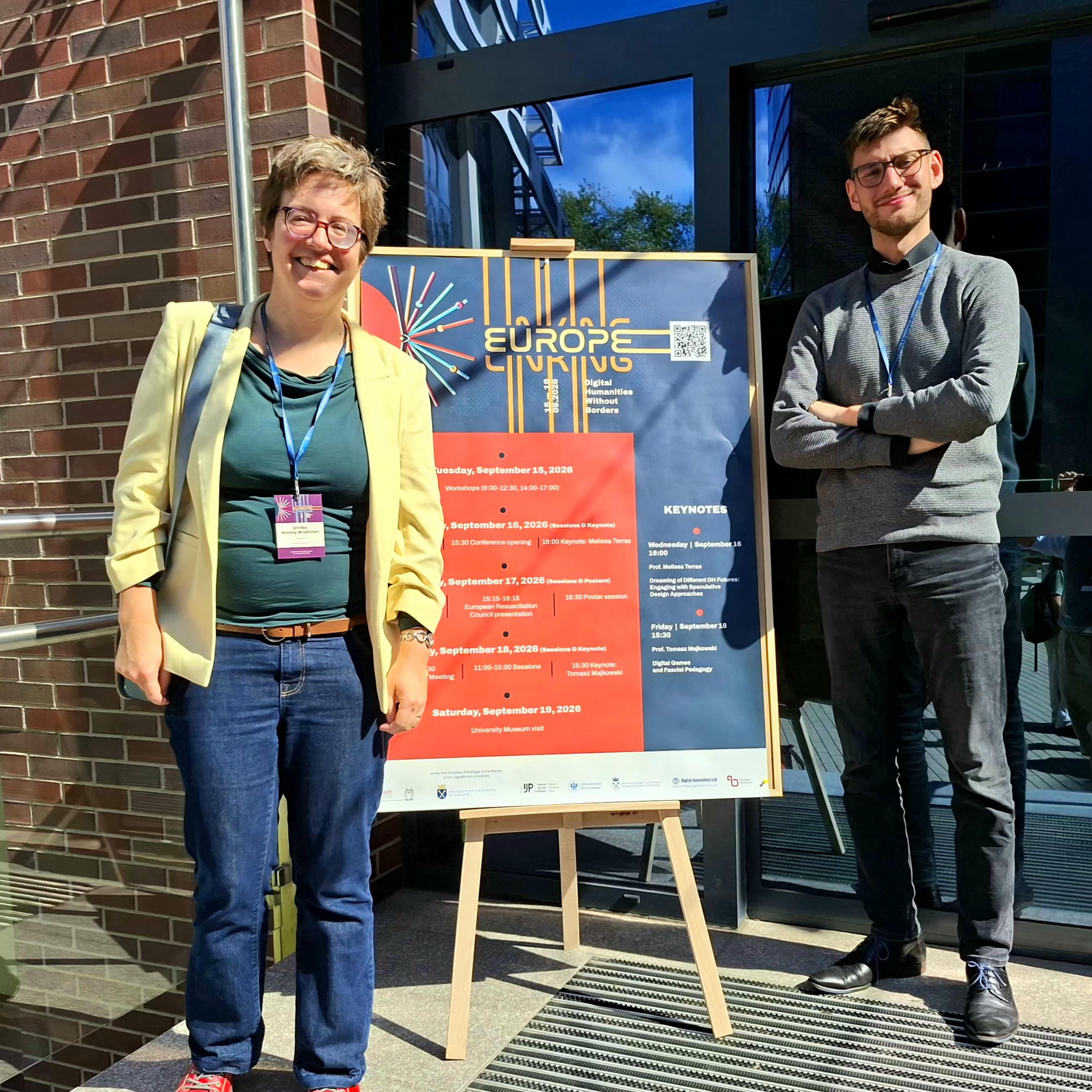

From 15 to 19 September 2026, the international Digital Humanities community gathered at Jagiellonian University in Kraków for the European Association for Digital Humanities (EADH) Conference 2026. Under the theme “Linking Europe: Digital Humanities Without Borders”, the conference brought together researchers from across Europe and beyond to explore connections across scholarly communities, methods, infrastructures, and disciplinary boundaries. Following previous editions in Galway in 2018 and Krasnoyarsk in 2021, Kraków hosted the third EADH conference in this series, organised in years when the international Digital Humanities Conference of the ADHO takes place outside Europe.
On 16 September, Ulrike Henny-Krahmer and Erik Renz presented their long paper “DH as Linked Communities”. The contribution emerged from the research project Lectures that Link, developed within the Rostock Working Group for Digital Humanities (RosDH). The project analyses European DH lecture series as sites of scholarly interaction, using their structure and content to investigate thematic developments as well as institutional and personal networks within the field. Its data and scripts are openly available on GitHub.
Building on this broader project, the conference paper asked a deceptively simple question: to what extent do the people who constitute Digital Humanities communities in different academic settings actually overlap? Henny-Krahmer and Renz brought together two perspectives that are usually studied separately, comparing participation at nine annual conferences of the German-speaking Digital Humanities association (DHd) with speakers appearing in 30 fully documented DH lecture series in Germany, Austria, and Switzerland.
The full abstract is included in the EADH 2026 Book of Abstracts. The abstract and presentation slides are also archived separately on Zenodo, while an online version of the presentation is available as well.