


A conference report on Editopia 2026 by Charlotte Grünig.
From 2 to 4 September 2026, I had the opportunity to attend Editopia 2026 in Wuppertal, organised by the Institute for Documentology and Scholarly Editing (IDE). Under the theme “On the Future of Documentology and Scholarly Editing in the Post-Digital Age”, the conference marked the IDE’s 20th anniversary while also reflecting on how digital scholarly editing might develop over the next 20 years.
As a (Very) Early Career Researcher, I was able to attend thanks to a travel grant from the DHd Association for conferences related to the Digital Humanities. Since this was my first academic conference and I am still at a very early stage in my career as a digital humanist, I am particularly grateful for this opportunity. I would also like to thank the team at the University of Wuppertal and everyone involved from outside the university for putting together such an engaging conference.
Editopia covered an exceptionally broad range of topics. Among the recurring themes were fluidity, for example in Christian Lück’s paper “Who's got the makings? Fluide Transkriptionen als (musik)philologische Herausforderung”; sensitivity to discrimination, as in Elias Zimmermann and Levyn Bürki’s “Diskriminierung (nicht) edieren. Diskriminierungssensible Editions-Richtlinien am Beispiel der digitalen Edition Annemarie Schwarzenbach”; and born-digital materials, discussed, for instance, in Giuseppe Arena’s “Processuality, Instability, and the Ecdotic Challenge of Born-Digital Electronic Poetry”. These discussions were linked to a wide range of scholarly editing projects from Romance Studies, German Studies, Musicology, History, and many other fields.
One issue repeatedly resurfaced across all these thematic strands, both in the papers and in the discussions: the use of AI, its possibilities, and the problems it raises. Can an edition produced by a machine still be considered scholarly, or does scholarly editing necessarily require human authorship? Will large-scale editorial projects still be needed in the future, or might researchers simply use AI to generate editions tailored to their individual research questions? And what would happen if AI were eventually able to produce editions of a higher quality than humans could?
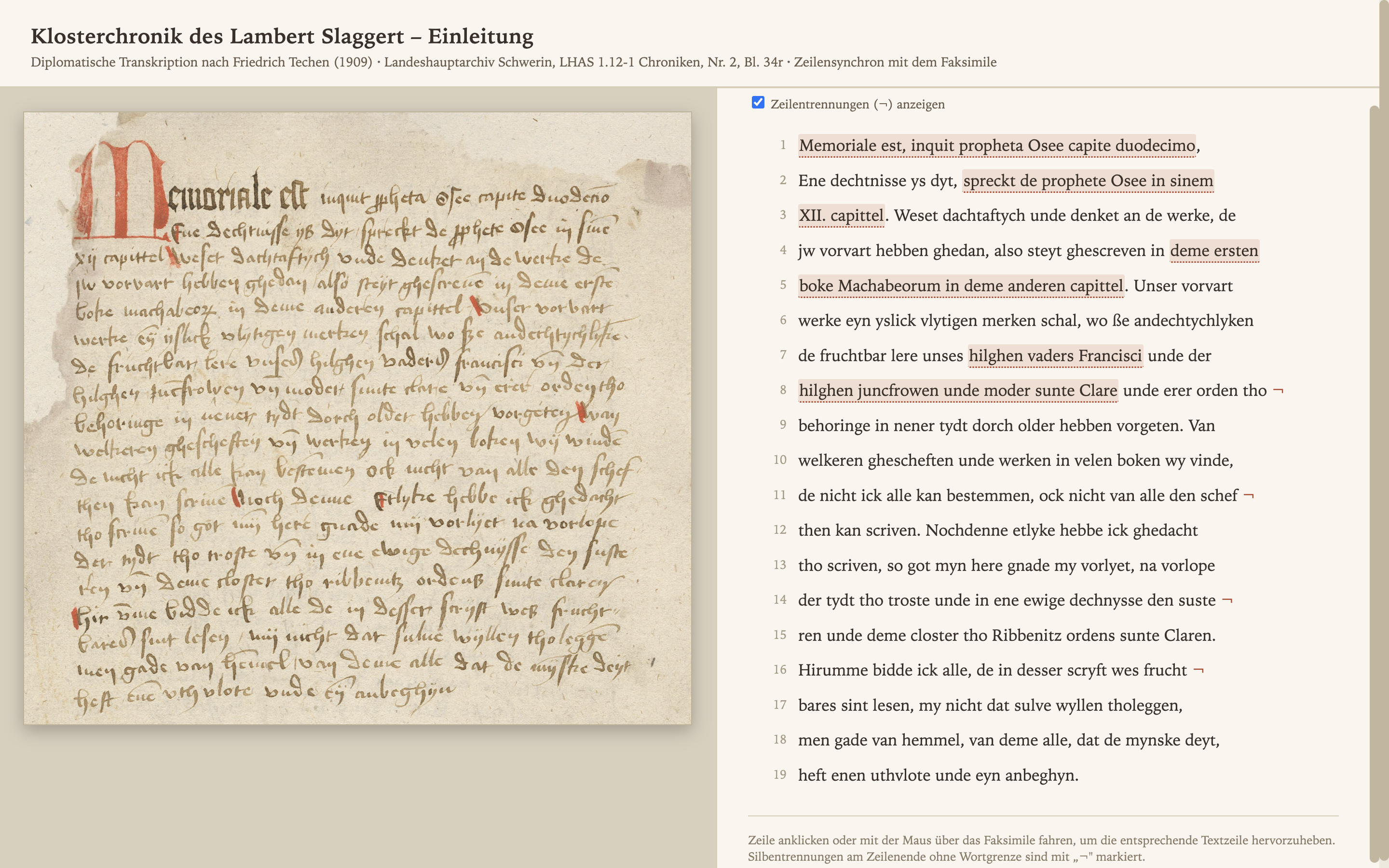
As someone who is personally rather ambivalent about, and at times sceptical of, AI, I was not entirely surprised by these discussions, but I was struck by both their scope and depth. Rather than being put off by the subject, however, conversations with other participants gave me an idea: I wanted to conduct a small experiment and find out for myself what is currently possible for a relative ‘layperson’ using a large language model. With Anthropic’s Claude AI (Sonnet 5), I therefore set out to create a ‘mini-edition’ of the opening chapter of the German chronicle of Ribnitz Convent, a text I had already worked with extensively during my studies in History and Latin at the University of Rostock.
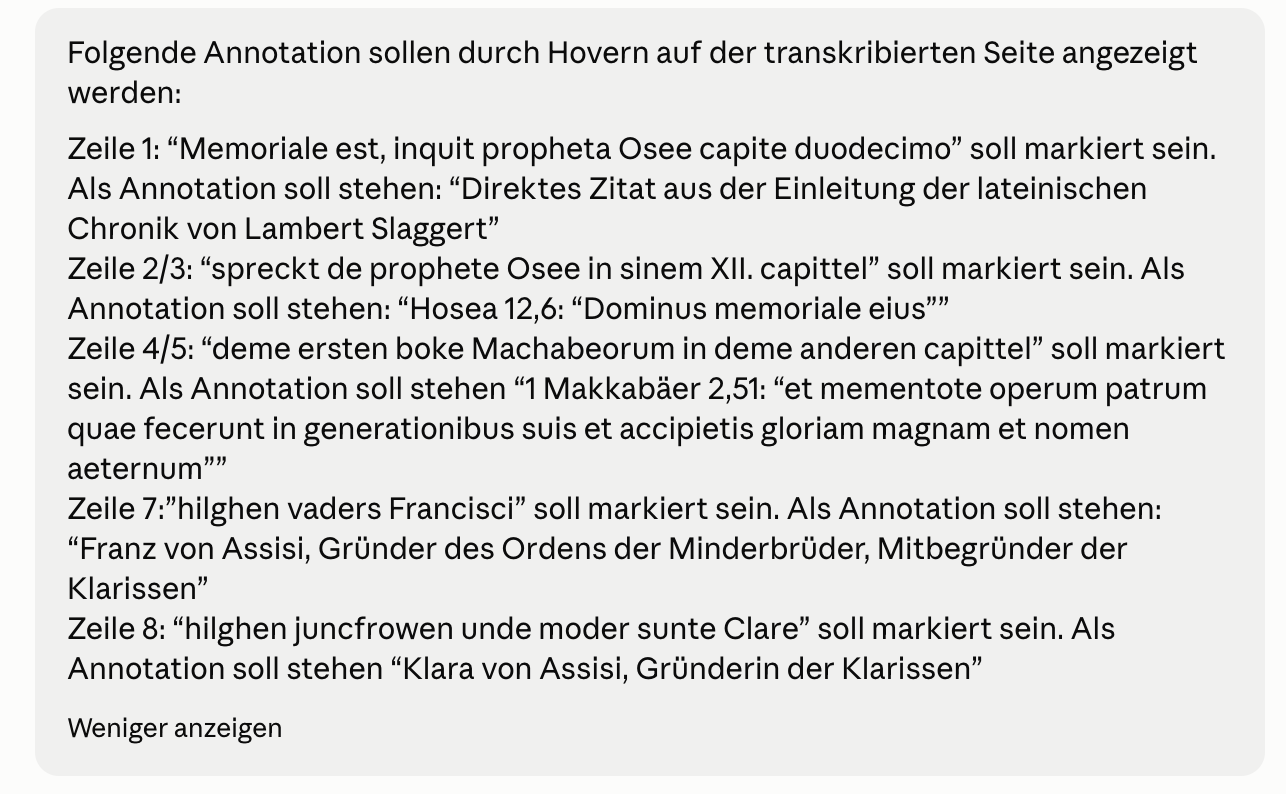
It was important to me that the facsimile should be displayed alongside the transcription. I also wanted corresponding lines in the two versions to be highlighted when hovering over them with the mouse, as well as annotations within the transcription that would appear on hover.
Initially, I assumed that this would be extremely time-consuming. All I had to work with was a DOCX file containing a transcription of the chapter based on Friedrich Techen’s 1909 edition of the text, together with a facsimile from the Mecklenburg-Vorpommern State Main Archive in Schwerin. Yet after only two prompts, I had a functioning line-synchronised mini-edition, and with a third prompt I was able to add all the annotations.
For the experiment, I created a GitHub repository and used GitHub Pages to publish the result as an HTML page.
Despite everything that had been discussed at the conference, I was initially surprised by just how straightforward the process had been. My basic knowledge of XML and HTML was sufficient for me to understand enough of the output to make small changes to the content myself. It quickly became clear, however, that I did not understand many of the finer details, such as why certain elements in the HTML structure had been implemented in a particular way, and that with my current level of knowledge I would not be able to make substantial structural changes from scratch.
For that reason, I believe that this kind of ‘pure generation’ of editions through large language models is still a long way off for non-specialists, particularly because the larger an edition becomes, the more difficult it is to verify what has been produced. I remain very curious, however, to see what experts will be able to do with this technology in the future — or whether it will ultimately prove to be a bubble and we will soon move on to other technologies altogether. Above all, I came away with the realisation that I need to engage much more deeply with the technical side of the Digital Humanities.
Despite my initial concern that I might still be too early in my academic career to benefit meaningfully from Editopia, I took an enormous amount away from the conference, and not only in terms of its scholarly content. I met inspiring people, developed a new sense of what the Digital Humanities can be, and felt encouraged to experiment with new ideas myself. Thanks to these experiences, I now look towards my future in the Digital Humanities with considerably more confidence!
Note: This English translation was produced automatically with ChatGPT.